PPP Convergence Time: What It Is and How to Keep It Short
Why PPP needs minutes, what ‘converged’ means, and the habits that get you working fastest.
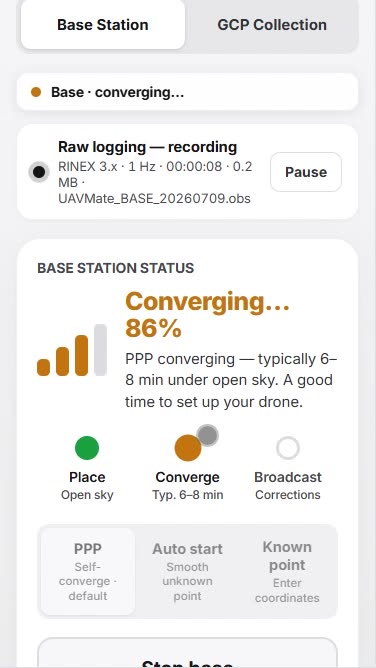
What is actually happening during those minutes
Convergence is the visible face of ambiguity resolution. A PPP engine receives precise satellite orbits, clocks, and biases, then must separate the remaining unknowns in its carrier-phase observations: its own position, receiver clock, atmospheric delays, and an integer number of wavelengths to each satellite. At power-on those unknowns are entangled; as geometry shifts and multi-frequency measurements accumulate, the estimator untangles them and the position uncertainty collapses — metres, decimetres, centimetres. When ambiguities lock to integers (PPP-AR), the solution snaps to its final precision and stays there. The console's shrinking error figure is that estimator narrating its own progress.
Nothing mystical governs the duration: it is information arithmetic. More frequencies, more constellations, better corrections, and cleaner sky all mean faster untangling.
Typical numbers across the industry
Modern regional-augmented L-Band services converge fast: about 3 minutes to ~1.5 cm horizontal is the working figure for the service behind UAV Mate; CHCNAV quotes PointSky at 2.5 cm within 3–5 minutes; Trimble's CenterPoint RTX Fast regions initialize in around a minute, standard RTX in the tens of minutes elsewhere. Free in-band services (Galileo HAS, BeiDou B2b) currently sit at decimetres-in-minutes and improving. For contrast, DJI specifies its D-RTK 3 satellite-differential mode at 30 cm / 40 cm after roughly 20 minutes — honest engineering for its purpose, and a useful calibration of what “convergence” means at different service tiers. RTK initialization, incidentally, is a different animal: seconds, because a nearby base collapses the atmosphere unknowns outright — which is exactly why the PPP-base-plus-RTK-rover architecture puts the wait on one device only, once per setup.
What stretches convergence — and what doesn't
Sky obstruction dominates. Canopy, canyon walls, buildings, and the receiver's own operator standing over it all thin the observation diet; partial sky can double or triple the wait, and a badly shadowed L-Band path can stall it. Ionospheric weather is the second lever: storm days lengthen everyone's initialization, multi-frequency hardware least. Multipath from nearby metal adds noise the estimator must average down. What doesn't matter is comfortingly long: latitude (within service beams), temperature, cellular coverage, time of day in any consistent way, and — for a base — motion, since it has none. Placement is thus the entire craft: the difference between a 3-minute and a 10-minute morning is usually five metres of walk toward open sky.
Working with convergence instead of against it
Field crews dissolve the wait with sequencing: power the base first, converge during aircraft assembly and mission upload — by the time the Matrice's props are on, the base is serving corrections, and perceived wait is zero. Re-occupations are quick: a base restarted at the same spot re-converges faster than cold, and holds its locked coordinates through brief L-Band dropouts once converged. For programs with fixed sites, leaving the base powered (USB-C, 5–20 V) makes convergence a once-per-deployment event rather than a daily one. And when a site is genuinely hostile — a slot canyon pad — converge in the open nearby, then relocate is not an option for PPP (position restarts), so instead let radio carry corrections from the open-sky base into the hole: the architecture, again, absorbs the physics (remote patterns).
Reading a convergence display like an engineer
A good status page shows estimated error shrinking, satellites used per constellation, and correction-stream health. Healthy convergence is monotonic with small wobbles; three pathologies break the pattern. Plateau at decimetres: correction stream interrupted or single-frequency tracking — check L-Band lock and antenna sky view. Convergence then a jump: the receiver was disturbed or a severe multipath transient; let it settle, and avoid handling the unit mid-initialization. Repeated restarts of the countdown: power interruptions or a receiver being carried while converging — PPP wants stillness. Each pathology names its own fix, which is the point of watching the display at all rather than waiting on faith (the broader triage script).
Does the wait matter? The honest accounting
Three minutes against the alternatives: levelling a tripod over a monument (ten-plus minutes, and a monument must exist), averaging a position (any number of minutes, and the result is not absolute), static logging for OPUS/AUSPOS (hours to next-day), or a 20-minute satellite-differential wait for decimetres. Convergence is the cheapest absolute-coordinate acquisition process fieldwork has ever had — and since it runs unattended while the crew does literally anything else, its practical cost rounds to zero. The residual duty is simply honesty in planning: quote “about three minutes under open sky”, and let obstructed sites budget a few more.
Convergence versus initialization: getting the vocabulary right
Two different waits share loose language, and conflating them muddles buying decisions. PPP convergence is the minutes-long, once-per-setup process of a receiver establishing absolute position from satellite corrections — the base's job. RTK initialization is the seconds-long ambiguity fix a rover performs against a live base — recurring after signal loss, but nearly instant. Spec sheets exploit the blur: ‘instant centimetre accuracy’ usually describes rover initialization against infrastructure someone else converged or surveyed. The honest ledger assigns each wait to its owner: in the PPP-base architecture, the minutes live at the base exactly once per setup, and every rover on site enjoys the seconds-class experience thereafter — the wait is not eliminated but relocated to where it costs nothing.
Budgeting convergence into mission planning
Operationally, convergence is a scheduling primitive like battery charging. Single-site day: power the base on arrival; it is serving before the aircraft is assembled — budget zero. Multi-site day: the leapfrog pattern — converge site B's base (or re-site the same unit) while site A demobilizes; three minutes hides inside every pack-down. Time-critical windows (tide, blast clearance, light): converge early and let the base hold, since a converged base keeps its locked coordinates indefinitely; the window consumes rover minutes only. The only unbudgetable convergence is the one attempted in the wrong place — under the canopy edge, beside the highwall — which is why the placement habit is the entire skill (placement craft).
One-line takeaway
Convergence is ambiguity resolution narrated in real time: give the antenna open sky, sequence the wait behind aircraft assembly, and the three minutes that buy centimetre-absolute coordinates round to zero in every honest schedule — which is why the PPP-base architecture puts them at one device, once.
Further reading
What the L-Band correction stream contains and who operates the services is covered in L-Band PPP explained.
Frequently asked questions
Why does PPP take minutes when RTK takes seconds?
RTK borrows a nearby base's atmosphere and geometry, collapsing the unknowns instantly. PPP estimates them from scratch using global corrections — a few minutes of information gathering.
Does convergence restart if the signal drops?
Brief L-Band gaps are bridged and a converged base holds its locked position. Extended loss during initial convergence restarts the estimate; after locking, the base keeps broadcasting regardless.
Can I speed convergence up?
Placement is the lever: full sky, away from metal and canopy. Multi-constellation tracking and dual-beam correction reception do the rest automatically.
Is the converged position the same every time?
Yes, within the service's accuracy (~1.5 cm class) — that repeatability in ITRF2020 is precisely what makes datasets from different days overlay without adjustment.
Centimetre RTK. No CORS. Anywhere.
UAV Mate is a self-converging PPP/RTK base station: 1.5 cm ITRF2020 coordinates in minutes, broadcast to any RTCM 3.x drone or rover.
See UAV Mate